GEO: QUIET
3
A/B (quiet)
Geomagnetic conditions are currently quiet with a Kp-index of 0.7. Solar activity remains stable, with no significant disturbances expected in the next 24 hours.
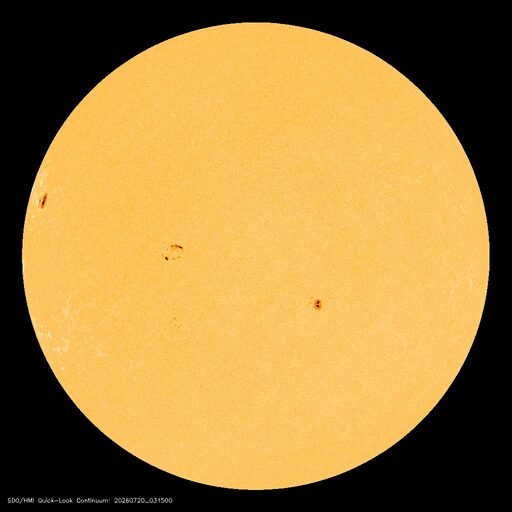
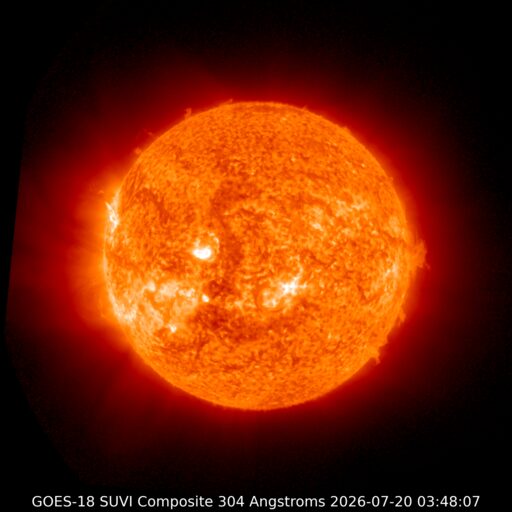
The solar environment is currently in a quiet state across all observational metrics. While 26 active regions are present on the disk, overall flare production remains low, with only minor C-class activity recorded in the last 12 hours. The F10.7 solar radio flux is at 129.0 sfu, indicating moderate levels of solar irradiance.
The current Kp-index of 0.7 confirms a stable magnetosphere, ensuring no disruptions to satellite or electrical grid operations.
Geomagnetic activity is expected to stay at quiet levels, with the Kp-index forecast to remain below 2.0 throughout the next 24 hours. Radio propagation remains stable, and no significant space weather impacts are anticipated for satellite or ground-based operations.
Aurora activity is currently restricted to high latitudes. Observers at mid-latitudes (40-60°N) should not expect any visible aurora displays given the current low geomagnetic levels.
| Region | Location | Class | Flares C/M/X |
|---|---|---|---|
| AR4492 | N15E73 | Hax/A | 0/0/0 |
| AR4489 | S07W12 | Cso/B | 0/0/0 |
| AR4491 | S11E21 | Axx/A | 0/0/0 |
Monitor the evolution of active region AR4492 as it rotates onto the disk, as its complex magnetic configuration maintains a 40% probability of M-class flares.