M @ 23:58 UTC · M @ 00:29 UTC · M @ 01:06 UTC · M @ 01:57 UTC · M @ 03:28 UTC
GEO: ACTIVE
4
M1–M4
Geomagnetic activity has reached G2 (Kp 6) levels, driven by recent solar disturbances. Multiple active regions are currently producing frequent M-class flares, sustaining an R1 radio blackout environment.
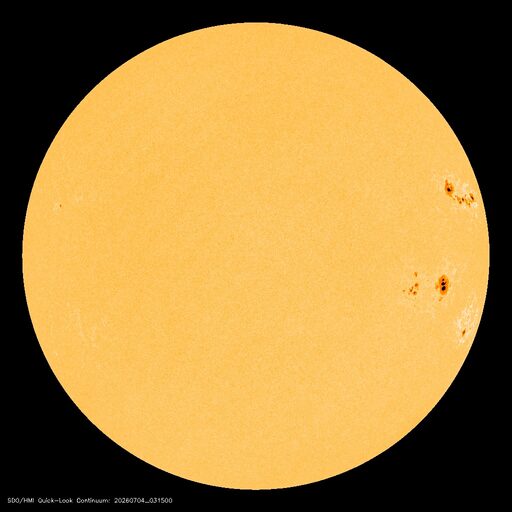
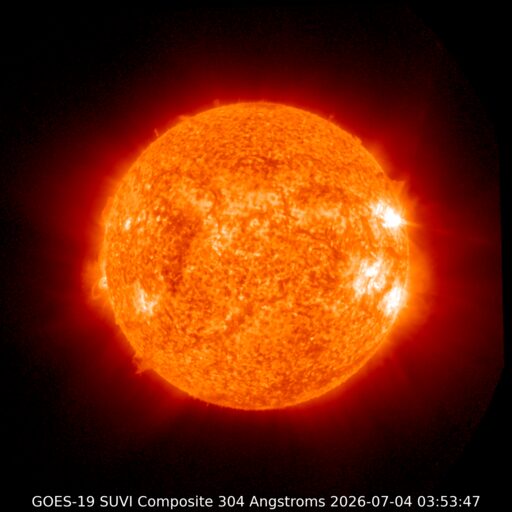
The geomagnetic field is significantly disturbed with a Kp-index of 6.0, indicating a G2-level storm in progress. Solar activity is high, with 33 active regions identified and five M-class flares recorded in the last 12 hours. The F10.7 flux remains at a moderate 132 sfu, reflecting the high complexity of the current solar disk.
The Kp-index of 6.0 is the critical metric, confirming a G2 geomagnetic storm that may induce minor power grid fluctuations and affect satellite tracking for low-earth orbit assets.
Geomagnetic conditions are expected to gradually subside from G2 to unsettled levels (Kp 4) over the next 12 hours. Persistent M-class flare activity remains likely given the complex magnetic configurations of AR4478, AR4479, and AR4480.
Auroral displays are currently possible at mid-latitudes, including northern regions of the United States and Central Europe, as the G2 storm persists. Observers should look toward the northern horizon, though visibility will likely decrease as the storm wanes over the next 6-12 hours.
| Region | Location | Class | Flares C/M/X |
|---|---|---|---|
| AR4481 | N14E62 | Hsx/A | 0/0/0 |
| AR4479 | N17W66 | Fkc/BGD | 6/1/0 |
| AR4480 | S18W70 | Eai/BG | 1/2/0 |
| AR4478 | S06W46 | Fko/BG | 2/2/0 |
Monitor the M-class flare rate for potential escalation to X-class intensity, which would significantly increase the risk of R3+ radio blackouts.